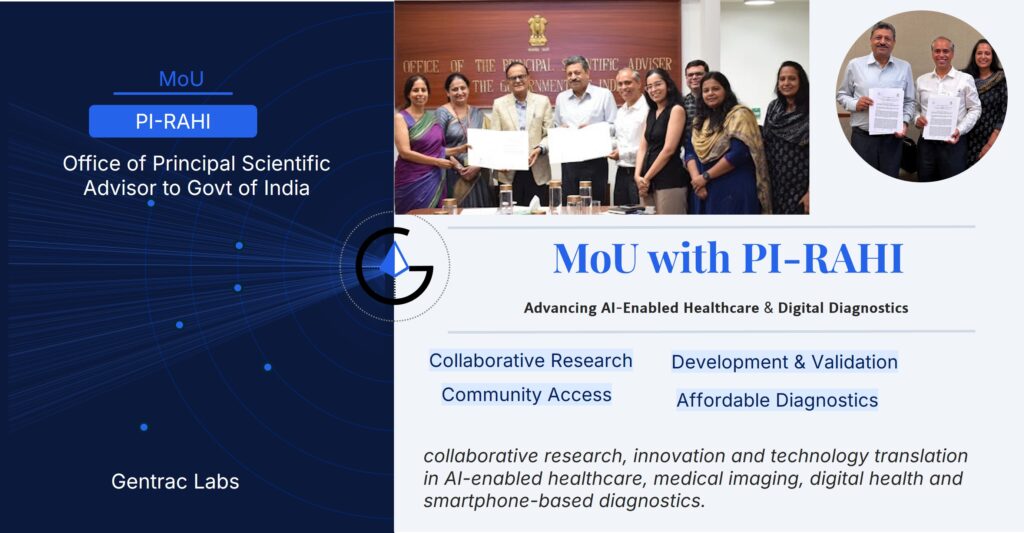
On 13th August 2026, Gentrac Labs signed a milestone institutional partnership with PI-RAHI: Northern Region S&T Cluster, of the Office of the Principal Scientific Adviser to the Government of India.
Anaemia affects 67% of children under 5, 57% of women of reproductive age and 52% of pregnant women in India. Neonatal Jaundice is another major challenge, with dangerously high bilirubin contributing to thousands of newborn deaths and lifelong complications every year. Yet much of our diagnostic infrastructure remains centralized.
In February this year, we set out to solve a different problem: how do we make clinical AI work reliably across millions of edge devices? Every smartphone captures images differently, and device, camera, lighting and image-processing differences can affect AI performance.
Together the core team at Gentrac Labs, built NormaEngine to standardize smartphone images across devices and real-world conditions. On top of it is HbPRISM, our AI platform for non-invasive hemoglobin and bilirubin assessment from smartphone images- without a blood draw or complex laboratory infrastructure.
Our vision: bring objective diagnostics to the point-of-care and ultimately the last-mile, using a smartphone. We incorporated in June, have filed a provisional patent, and are now developing our clinical program across community, OPD and neonatal settings.
We are not in the market or regulatory approved yet. What we have is a validated proof of concept, a defined regulatory pathway, and now, through PI-RAHI, under the guidance of Prof Rajat Sandhir, the institutional access to generate the evidence.
We’re looking to collaborate with research institutions, healthcare organizations and impact investors who share our conviction that early diagnostics should be accessible to all.
Sudipta Roy, Anwesh Kabiraj, Shikha Malhotra
Indian Council of Medical Research (ICMR)